
Forced Convection Oven
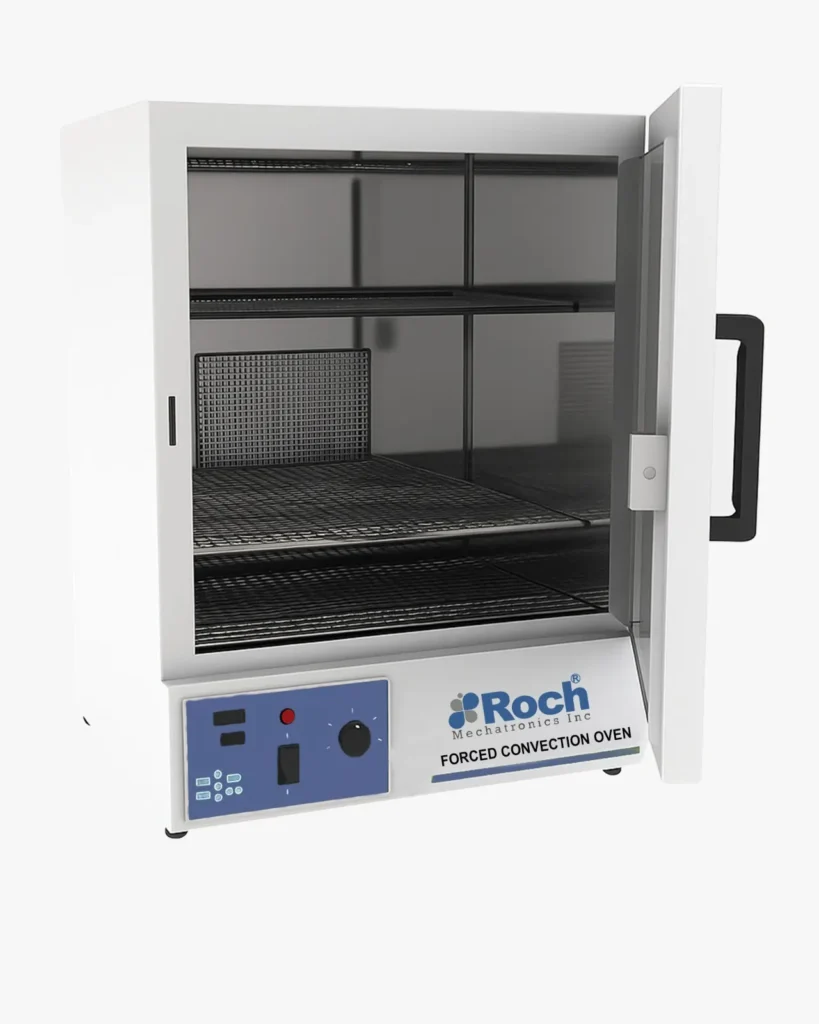
Forced Convection Oven Specifications
| Specification | Details |
|---|---|
| Product Name | Forced Convection Oven |
| Oven Type | Forced Air Circulation Laboratory Oven |
| Temperature Range | Ambient +10°C to 250°C (Optional up to 300°C) |
| Temperature Accuracy | ±1°C |
| Temperature Uniformity | ±2°C |
| Heating System | Electric Tubular Heaters |
| Air Circulation | Forced Convection by Heavy Duty Motorized Blower |
| Controller | Microprocessor Based PID Digital Temperature Controller |
| Display | Digital LED Display |
| Timer | 0–999 Minutes / Continuous Operation |
| Inner Chamber Material | SS304 Stainless Steel |
| Outer Body | Powder Coated Mild Steel |
| Insulation | High Density Mineral Wool |
| Door Type | Single Hinged Insulated Door |
| Viewing Window | Optional Toughened Glass Window |
| Shelves | Adjustable Stainless Steel Wire/Perforated Shelves |
| Capacity | 28 Ltr to 1000 Ltr |
| Power Supply | 220–240V AC 50 Hz / 415V AC 3 Phase (Large Models) |
| Safety Features | Over Temperature Protection and Fuse Protection |
| Air Ventilation | Adjustable Air Exhaust Vent |
| Mobility | Optional Heavy Duty Castor Wheels |
| Applications | Drying Baking Curing Sterilization Aging Testing Laboratory and Industrial Use |
| Model | Capacity | Suitable Applications |
|---|---|---|
| Forced Convection Oven 28 Ltr | 28 Litres | Research Laboratories |
| Forced Convection Oven 45 Ltr | 45 Litres | Quality Control Laboratories |
| Forced Convection Oven 90 Ltr | 90 Litres | Pharmaceutical Testing |
| Forced Convection Oven 150 Ltr | 150 Litres | Industrial Drying |
| Forced Convection Oven 250 Ltr | 250 Litres | Electronics Manufacturing |
| Forced Convection Oven 450 Ltr | 450 Litres | Production Laboratories |
| Forced Convection Oven 650 Ltr | 650 Litres | Automotive Components |
| Forced Convection Oven 1000 Ltr | 1000 Litres | Large Scale Industrial Applications |
Frequently Asked Questions (FAQ)
What is a forced convection oven and how does it work?
A forced convection oven uses a built-in fan or blower system to actively circulate heated air throughout the chamber, rather than relying solely on natural convection where warm air simply rises. This continuous air movement distributes heat more evenly around the items being processed, resulting in faster heating, more uniform temperatures, and shorter overall processing times compared to conventional ovens.
What is the typical temperature range for a forced convection oven?
Forced convection ovens generally operate anywhere from ambient temperature up to around 250°C to 300°C (482°F to 572°F), depending on the specific model and intended application. This range makes them suitable for a variety of tasks such as drying, curing, baking, sterilizing, or aging materials. Always refer to your unit’s specifications to confirm the exact range and any operating limits for your particular model.
What are the benefits of choosing a forced convection oven over a standard oven?
The primary advantage is temperature uniformity, since the active air circulation minimizes hot and cold spots that are common in natural convection ovens. This leads to more consistent results across multiple shelves or larger loads, faster heat-up and recovery times after the door is opened, and often improved energy efficiency due to more effective heat transfer. These benefits make forced convection ovens a preferred choice for applications requiring precision and repeatability.
What kind of maintenance does a forced convection oven require?
Routine care includes cleaning the interior chamber regularly to prevent buildup of residue or contaminants, checking and cleaning or replacing air filters as needed, and inspecting the fan motor and heating elements periodically for signs of wear. It’s also good practice to check door seals for any gaps that could cause heat loss and to calibrate the temperature sensors periodically to ensure readings remain accurate over time.
Is a forced convection oven suitable for my industry or application?
Forced convection ovens are widely used across many industries, including electronics, pharmaceuticals, food processing, automotive, and materials science, thanks to their versatility and reliable performance. Common applications include drying components, curing coatings or adhesives, sterilizing equipment, and conducting various heat treatment processes. Since suitability depends on factors like required temperature range, chamber size, and airflow needs, it’s a good idea to confirm these details align with your specific process requirements.