
Altitude Test Chamber Manufacturer
ROCH Mechatronics Inc. specializes in advanced testing solutions, offering top-quality Altitude Test Chamber designed to simulate extreme environmental conditions. Their High Altitude Test Chamber Manufacturer, Supplier and Exporter in India provides accurate simulations of altitude, temperature, and humidity for aerospace, automotive, and defense industries. Equipped with state-of-the-art technology, these chambers include an altitude chamber that ensures precision in testing components and equipment under pressure conditions. The temperature altitude chambers from ROCH are engineered to meet the highest standards, ensuring reliable performance in harsh environments, thus catering to diverse industry needs.
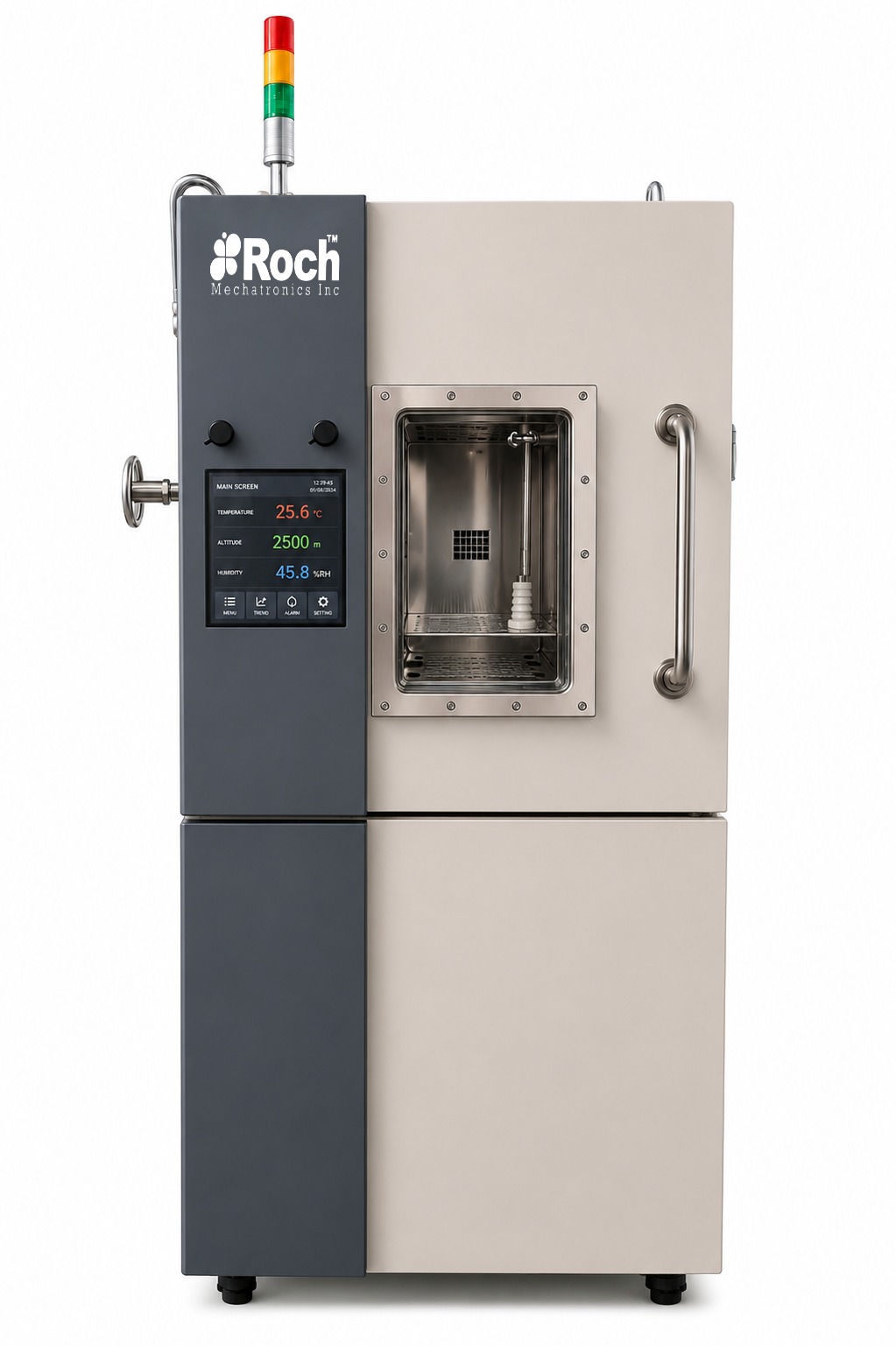
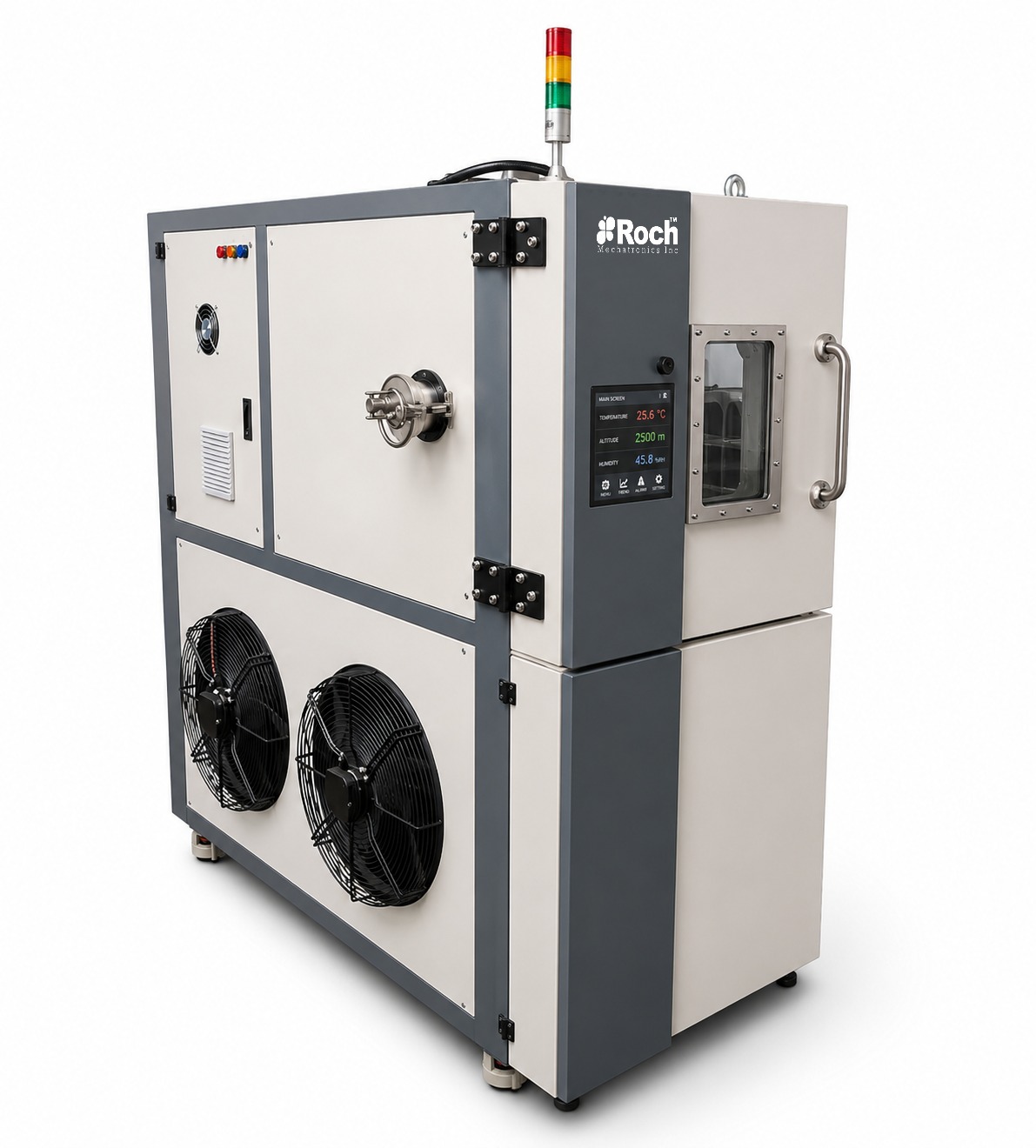
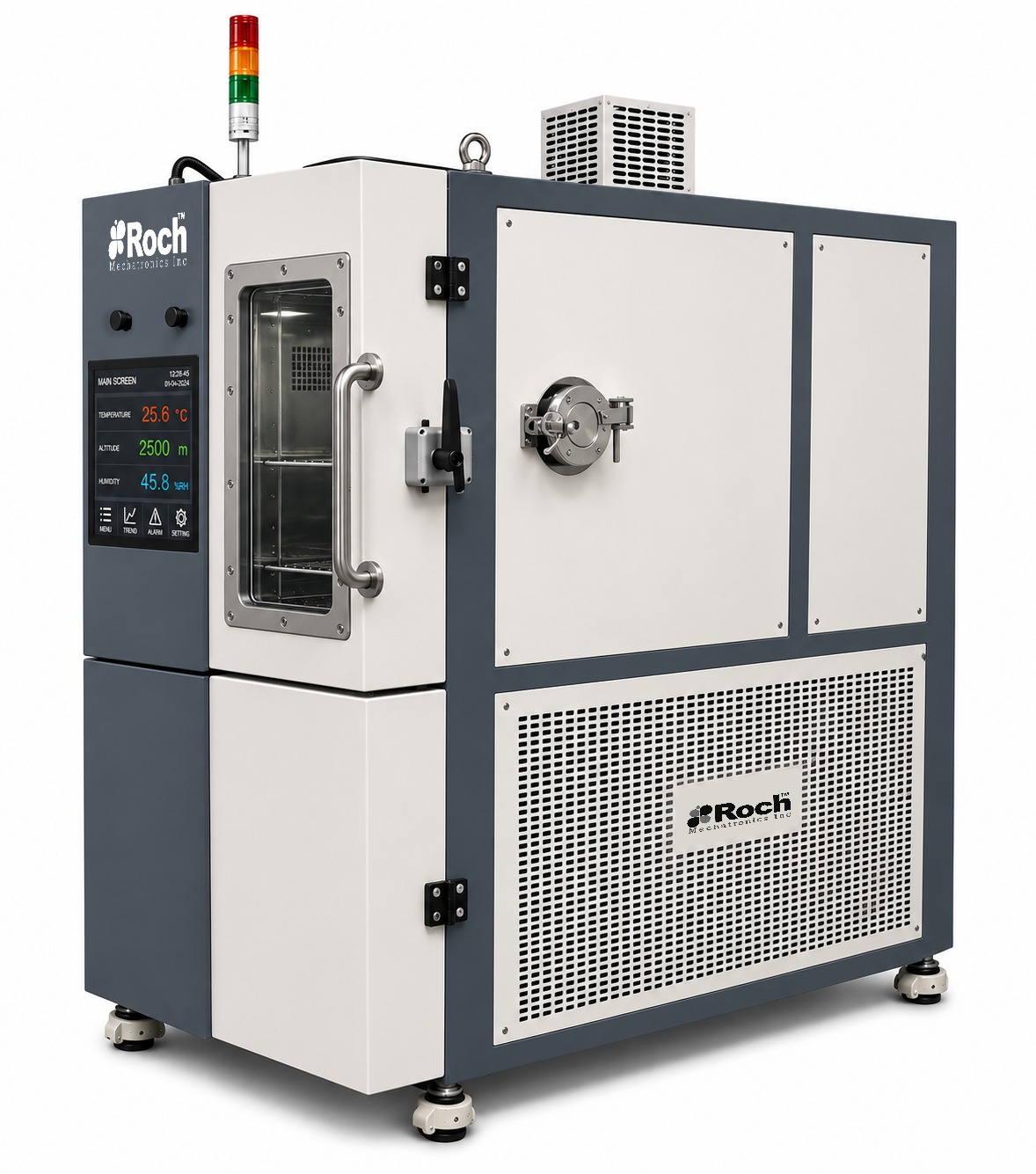
Altitude Test Chamber Features
- Brushed 304 series stainless steel liner, heliarc welded and dye-checked
- Welded external or internal pressure member construction
- Fiberglass insulation, 0.25k factor
- Welded steel frame with removable access panels to service components
- Full-opening chamber door with heavy-duty wheel latch
- Heavy-duty horizontal glide door hinges
- Durable blue enamel finishes (custom colors available)
- Heavy-duty vacuum pump with gas ballast Oil mist eliminator
- Temperature ranges: -100°F/-73°C to 356°F/180°C
- Altitude Chamber range: site level to 100,000 ft (30,500 m). Extended ranges available
- Humidity range: 10% to 95% RH within the bounds of a +185°F/85°C maximum dry bulb and a 40°F/4°C min.
- Dewpoint can be equipped with battery testing safety features according to the EUCAR hazard safety level
Controlled Testing Environment Capabilities
- Temperature and altitude (temperature controllable to 65,000 ft./20,000m)
- Temperature and humidity at site level
- Temperature, altitude, and vibration
- Rapid Decompression
Altitude chamber testing is important for manufacturers of products that might be shipped via air. It is especially important for defense and aerospace applications, where pressure and vacuum conditions are even more intense. Altitude temperature and altitude chambers offer performance flexibility and reliability for today’s mixed-environment testing requirements. A Russell’s application engineer can assist you in selecting the configuration, size, and elevation chamber options that best suit your needs.
Our Products
| Model | RIC-18 | RIC-37 | RIC-55 |
|---|---|---|---|
| Test Space Volume | 18/510 | 37/1048 | 55/1557 |
| (Cu. Ft./Liters) | |||
| Temperature Range | +180°C to -70°C (+356°F to -94°F) | ||
| Pressure Recovery Time | Less than 30 min | ||
| Pressure Maintenance | ?10 hours | ||
| High Tension Terminal | 4 pieces, Max. DC 500A,1000V | ||
| Low Tension Terminal | 4 pieces, Max. DC 500A,1000V | ||
| Data Cable Interface | 2 groups, DB9 line | ||
| Observe Window | YES | ||
| Auto Door | Adopt hydraulic automatic open design | ||
| Inner Material | SS304 | ||
| External Material | SS304 | ||
| Altitude Range | Up to 100,000 ft (30.48 km) | Up to 100,000 ft (30.48 km) | Up to 100,000 ft (30.48 km) |
| Humidity Range | 10% to 98% |
Frequently Asked Questions (FAQ)
What is an Altitude Test Chamber used for?
An altitude test chamber simulates the low-pressure and temperature conditions found at high altitudes, allowing manufacturers to evaluate how electronic components, aerospace parts, packaging materials, and other products perform when exposed to reduced atmospheric pressure. It helps predict how a product will behave during air transport, high-altitude operation, or rapid decompression events, without needing to physically take it to those environments.
What altitude range and pressure levels can these chambers typically simulate?
Most commercial altitude test chambers can simulate elevations ranging from ground level up to around 100,000 feet, corresponding to pressures as low as a few torr. The exact range depends on the chamber model and vacuum pump capacity, so it’s important to match the chamber specification to the altitude conditions your product actually needs to withstand, whether that’s commercial aviation cruising altitude or near-space conditions.
Can temperature and humidity be tested together with altitude in the same chamber?
Yes, many altitude chambers are combined with temperature and humidity control systems, enabling combined environmental stress testing. This lets engineers evaluate how a product responds to simultaneous low pressure, temperature extremes, and moisture exposure, which more closely mirrors real-world conditions during flight or high-altitude deployment than testing each variable separately.
How long does a typical altitude test take?
Test duration varies widely depending on the industry standard being followed and the purpose of the test. A rapid decompression test might last only a few minutes, while a soak test evaluating long-term material stability at altitude could run for several hours or even days. The chamber’s pump-down rate and the specific test protocol, such as those from RTCA DO-160 or MIL-STD-810, will determine the overall timeline.
What industries commonly rely on altitude test chambers?
These chambers are widely used in aerospace and aviation for testing avionics, seals, and cabin components, as well as in electronics manufacturing to verify that circuit boards and enclosures function correctly at reduced pressure. They’re also used in the packaging industry to check whether sealed containers or medical devices can withstand pressure changes during air freight, and in automotive and defense sectors for components destined for high-altitude or airborne use.