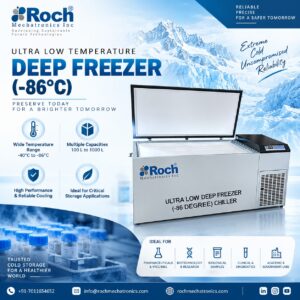
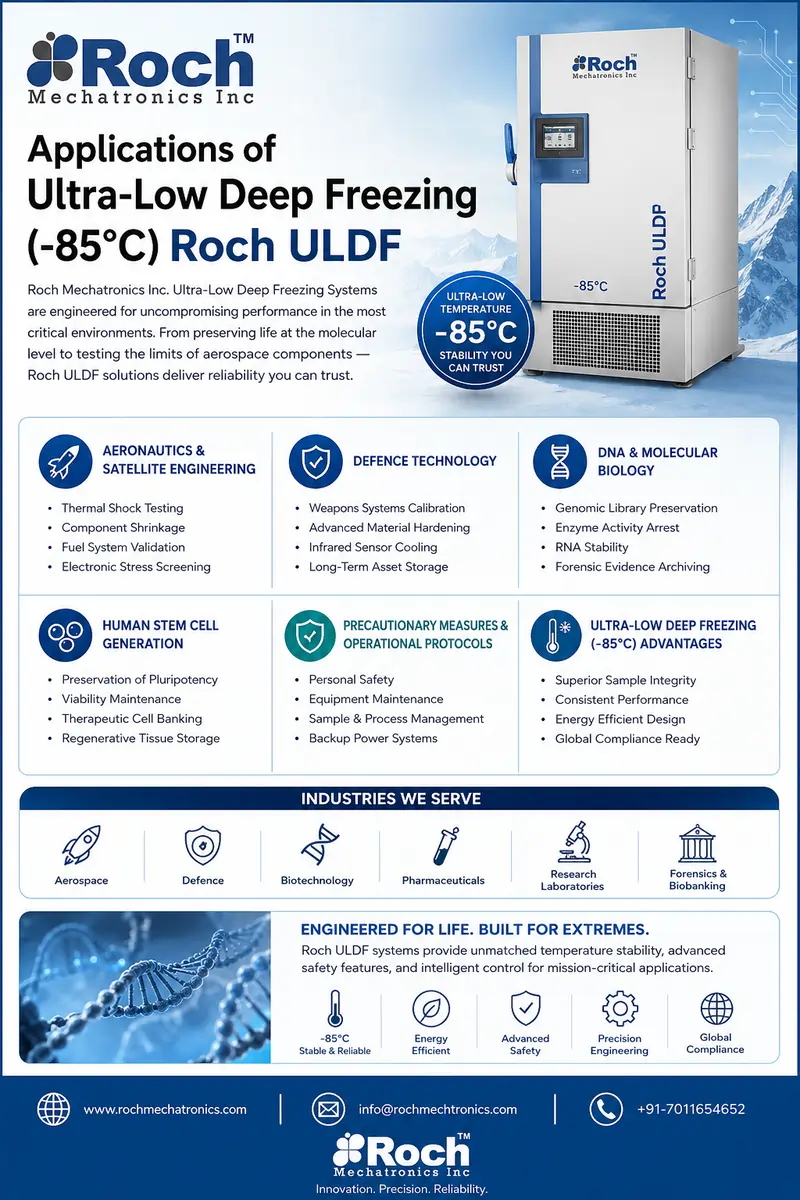
Ultra-Low Deep Freezing (ULDF) systems operating at -85°C are critical for industries that demand precise thermal control, biological preservation, structural stability, and long-term material integrity. The advanced freezing technology developed by Roch Mechatronics Inc. supports highly specialized applications across aerospace, defence, molecular biology, and regenerative medicine.
Aeronautics & Satellite Engineering
Thermal Shock Testing
Ultra-low temperature chambers simulate the extreme thermal environments encountered in outer space. Aerospace materials, avionics, and structural assemblies undergo rapid thermal cycling to evaluate resistance against thermal stress, cracking, and fatigue.
Component Shrinkage & Precision Assembly
Metals contract significantly at cryogenic temperatures, allowing engineers to perform precision interference-fit assemblies. Components such as bearings, turbine rings, and aerospace couplings can be fitted accurately without excessive mechanical force.
Fuel System Validation
Elastomers, seals, and fuel-line components are exposed to ultra-low temperatures to verify structural integrity, elasticity, and leak resistance under extreme operating conditions.
Electronic Stress Screening
Satellite circuit boards and aerospace electronics are tested under simulated high-altitude cold environments to identify weaknesses, solder fractures, and thermal instability before deployment.
Defence Technology
Weapons Systems Calibration
Lubricants, actuators, and moving weapon components must maintain operational performance in freezing environments. ULDF systems help validate cold-weather reliability and mechanical stability.
Advanced Material Hardening
Cryogenic tempering removes internal structural stresses from high-strength alloys and engineered metals. This process improves wear resistance, dimensional stability, and fatigue life.
Infrared Sensor Cooling
Infrared detectors achieve significantly higher sensitivity at ultra-low temperatures due to reduced thermal noise. This enhances surveillance, targeting accuracy, and imaging precision.
Long-Term Asset Storage
Solid rocket propellants and sensitive defence materials maintain chemical stability during extended storage periods under controlled ultra-low temperature conditions.
DNA & Molecular Biology
Genomic Library Preservation
High-molecular-weight DNA samples are preserved without fragmentation, ensuring long-term genomic integrity for research and sequencing applications.
Enzyme Activity Arrest
At ultra-low temperatures, metabolic and biochemical reactions cease almost completely. This prevents molecular degradation and preserves biological accuracy.
RNA Stability
RNA molecules are extremely sensitive to thermal degradation. ULDF systems maintain RNA stability for molecular diagnostics, transcriptomics, and gene-expression analysis.
Forensic Evidence Archiving
Biological evidence stored at ultra-low temperatures retains PCR-amplifiable quality, ensuring long-term reliability for forensic investigations and legal analysis.
Human Stem Cell Generation
Preservation of Pluripotency
Stem cells retain their differentiation potential indefinitely when preserved under stable ultra-low freezing conditions.
Viability Maintenance
Specialized cryoprotectants prevent intracellular ice-crystal formation, which can puncture cell membranes and damage cellular structures.
Therapeutic Cell Banking
Master cell banks for clinical therapies require ultra-low preservation to maintain sterile, genetically stable, and therapeutically viable cell populations.
Regenerative Tissue Storage
Engineered tissues and graft materials remain viable during transportation and pre-transplantation storage.
Precautionary Measures & Operational Protocols
Personal Safety
Cryogenic Gloves
Heavy insulated cryogenic gloves must be worn to protect against frostbite and extreme cold exposure.
Full Face Shields
Face shields and splash-resistant goggles protect technicians during sample retrieval and cryogenic handling.
Protective Laboratory Clothing
Lab coats, aprons, and closed footwear prevent accidental exposure to cryoprotectants and frozen surfaces.
Avoid Direct Metal Contact
Bare skin should never touch internal racks or metallic freezer components, as immediate tissue freezing may occur.
Equipment Maintenance
Regular Defrosting
Ice accumulation around door gaskets reduces sealing efficiency and compromises thermal insulation. Scheduled defrosting is essential for stable operation.
Vacuum Port Monitoring
Vacuum relief valves must remain unobstructed to ensure smooth door opening and pressure equalization.
Condenser Filter Cleaning
Monthly cleaning of condenser filters prevents compressor overheating and maintains refrigeration efficiency.
Ambient Temperature Control
ULDF systems should operate in well-ventilated, temperature-controlled environments to optimize compressor performance and energy efficiency.
Sample & Process Management
Cryogenic Vial Selection
Internally threaded cryogenic vials minimize explosion risks during warming and handling.
Controlled-Rate Freezing
Biological materials should be cooled gradually before final ultra-low storage to prevent intracellular ice formation.
Inventory Logging
Well-organized storage maps reduce door-opening duration and minimize thermal fluctuations.
Backup Power Systems
Ultra-low freezers should connect to UPS systems, auto-start generators, and liquid CO₂ or LN₂ emergency backup systems.
Comprehensive Matrix: Ultra-Low Deep Freezing (-85°C)
| Sector | Core Use Case | Primary Operational Risk | Critical Precaution |
|---|---|---|---|
| Aeronautics | Thermal shock testing & shrink-fitting | Material embrittlement & micro-cracking | Gradual structural warm-up phases |
| Satellite Engineering | Deep-space hardware validation | Outgassing & vacuum seal failure | Vacuum-rated material selection |
| Defence | Propellant & sensor optimization | Explosive ignition hazards | Explosion-proof circuitry |
| DNA Research | Long-term genomic archiving | Thermal fluctuation fragmentation | LN₂ backup installations |
| Stem Cell Banking | Pluripotency preservation | Intracellular ice crystal puncture | Controlled-rate freezing |
Phase Transitions & Thermodynamic Principles
Thermodynamic Equilibrium
At ultra-low temperatures, biochemical reactions and structural degradation processes nearly cease. Molecular motion reduces significantly due to a sharp drop in enthalpy, eliminating the free energy required for chemical degradation pathways.
Vitrification Mechanics
Biomaterials must transition into an amorphous, glass-like state to avoid crystallization. Ice crystal formation damages cell membranes and internal organelles, leading to irreversible biological destruction.
Thermal Expansion & Material Contraction
The contraction of materials under extreme cooling conditions follows the linear thermal expansion relationship:
ΔL=αL0ΔT
Where:
- ΔL = Change in linear dimension
- α = Coefficient of linear thermal expansion
- L0 = Initial length
- ΔT = Temperature differential
Incorrect thermal calculations can produce structural shear stresses, leading to joint failure and mechanical instability in aerospace systems.
Step-by-Step Protocols for -85°C Systems
1. Controlled-Rate Cooling
Biological samples must never be placed directly into a -85°C environment. A programmable cooling system should reduce temperatures gradually at approximately:
−1∘C/min
Cryoprotective agents such as Dimethyl Sulfoxide (DMSO) at approximately 10% concentration suppress freezing-point damage and prevent intracellular ice formation.
2. Mechanical Seal Maintenance
Frost accumulation weakens gasket insulation and disrupts thermal stability. Daily inspections and non-metallic frost-removal tools are essential to maintain operational performance.
3. Power Redundancy Engineering
Ultra-low systems require uninterrupted power support through UPS integration, auto-start generators, and emergency LN₂ or LCO₂ injection systems capable of handling compressor surge loads.
4. Personnel Safety Enforcement
Technicians should wear EN 511-certified cryogenic gloves, splash-resistant eye protection, and full-face shields. Laboratory environments should maintain a minimum of ten air exchanges per hour and include oxygen-deficiency monitoring systems.
Final Specifications
The operation of -85°C Ultra-Low Deep Freezing Systems requires strict adherence to thermodynamic cooling principles, material contraction physics, biological vitrification protocols, and redundant backup engineering systems. Proper implementation ensures long-term biological viability, equipment reliability, and structural integrity across highly sensitive industrial and scientific applications.